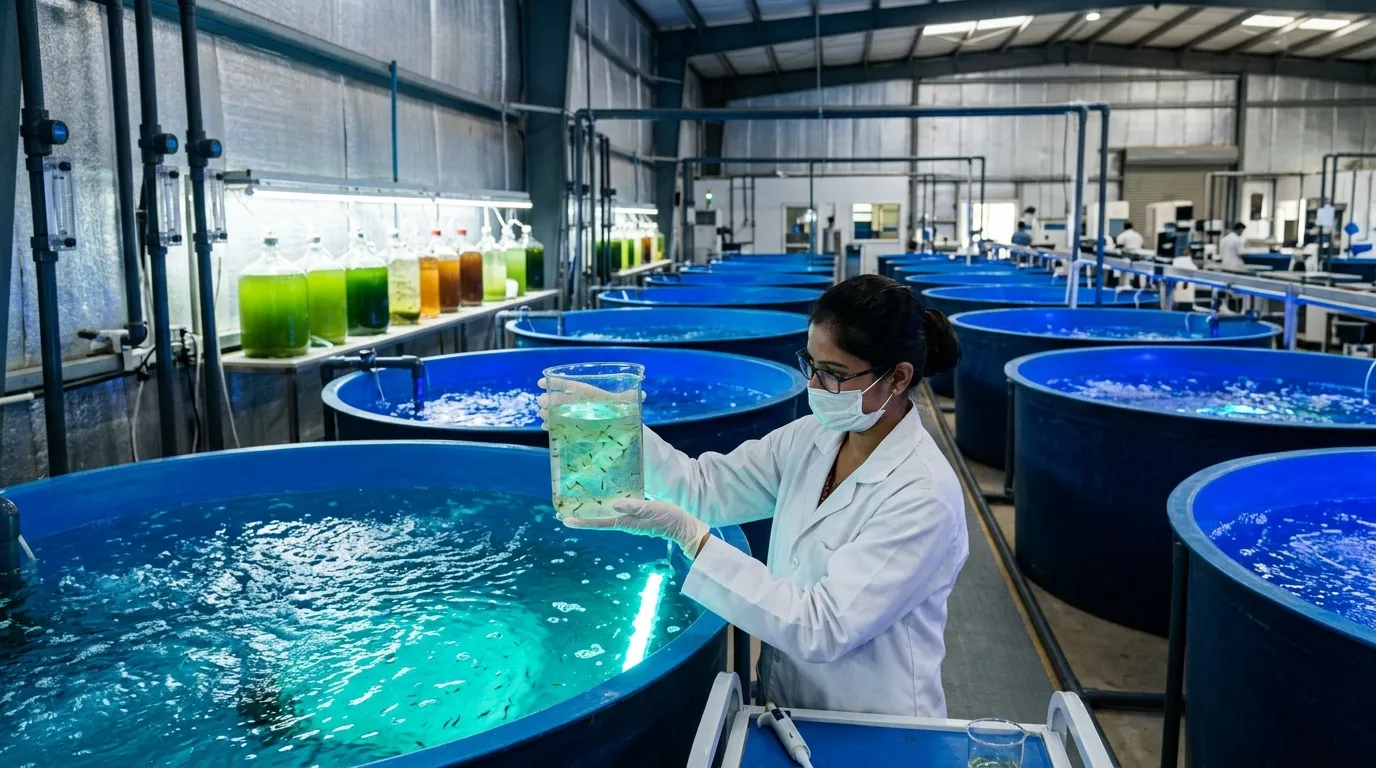
Key Operating Takeaways
- Maintain sterile bio-secure seawater (ozonated and UV-sterilized) across all larval rearing tanks.
- Feed live diatoms (Chaetoceros calcitrans @ 100,000 cells/mL) during Zoea 1 to Zoea 3 stages.
- Transition to enriched Artemia nauplii from Mysis 2 to PL 5 stages.
- Perform nested PCR testing on PL10 batches for WSSV, EHP, AHPND, and IHHNV before farm dispatch.
1. SPF Broodstock Conditioning & Spawning
Procure certified SPF (Specific Pathogen Free) broodstock from authorized quarantine centers. Maintain maturation tanks at 28°C–29°C with 30–32 ppt salinity and feed enriched squid, polychaetes, and spirulina.
2. Live Microalgae (Chaetoceros / Skeletonema) Culture
Cultivate pure monocultures of brown diatoms (Chaetoceros calcitrans and Skeletonema costatum) in sterilized seawater using Guillard's F/2 nutrient media to feed Zoea larvae.
3. Zoea, Mysis & Early Post-Larvae Feeding SOP
Zoea stages feed strictly on live diatoms. From Mysis 1 onwards, introduce newly hatched Artemia salina nauplii enriched with HUFA (Highly Unsaturated Fatty Acids) and microencapsulated larval feeds.
4. Stress Testing, PCR Certification & Farm Packing
Subject PL10–PL12 batches to a 30-minute freshwater (0 ppt) stress test (>95% recovery required). Submit 150 PLs for nested PCR screening before oxygen packing in double polyethylene transport bags.
Technical Frequently Asked Questions
What is the standard stress test for shrimp PL before purchasing?
Immerse 100 PLs in freshwater (0 ppt) for 30 minutes, then return them to normal salinity. If survival exceeds 95% after 30 minutes of recovery, the seed has strong vigor and osmotic resistance.